Last week we had an amazing win for our union.
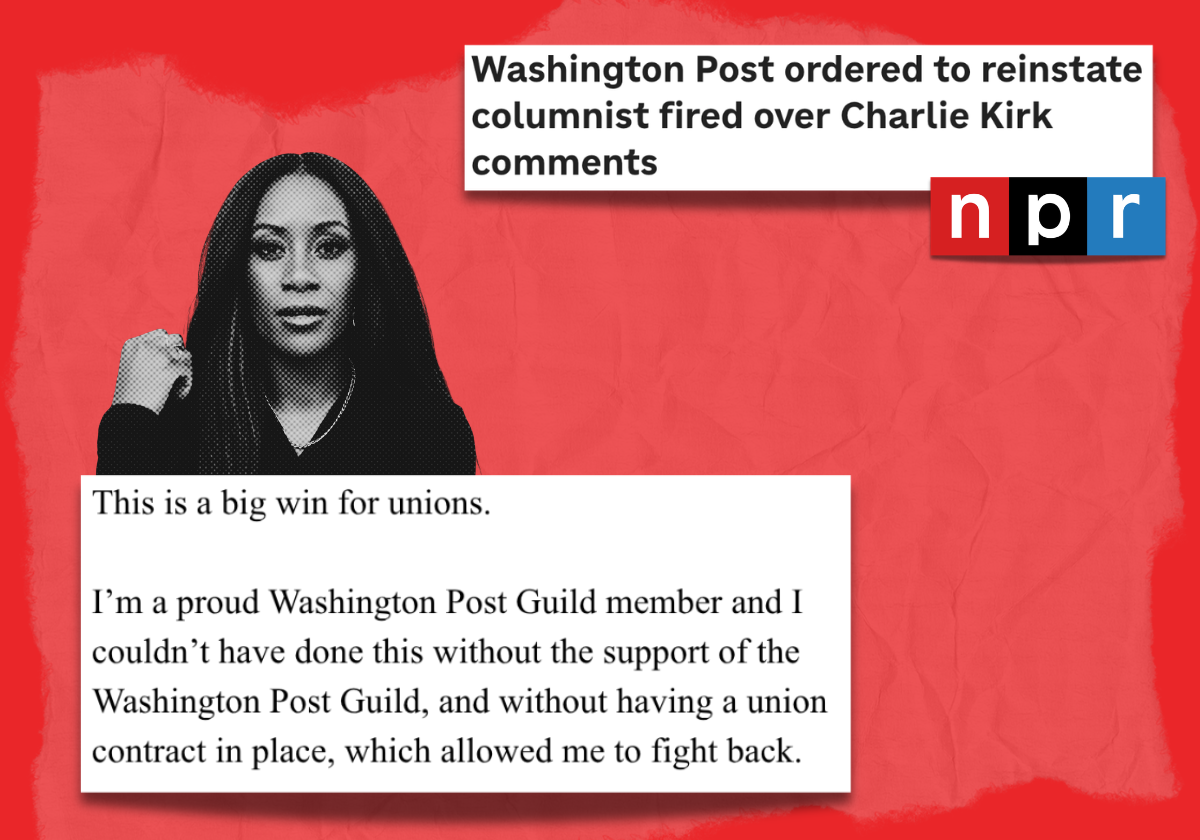
The Washington-Baltimore News Guild announced that an arbitrator ruled that the Washington Post must reinstate Karen Attiah to her job and pay her all the back pay since they inappropriately terminated her almost a year ago.
Attiah, who spent 11 years at the Post with an unblemished disciplinary record before rising to columnist and founding editor of its Global Opinions section, was terminated over two posts on Bluesky addressing racial double standards in the public response to political violence.
She’s a member of the Post Guild and is covered by the collective bargaining agreement. That contract says her termination must either be the result of progressive discipline or rise to the level of “gross misconduct.”
Post management argued Attiah’s Bluesky posts constituted “gross misconduct” that endangered staff safety.
The arbitrator disagreed.
The arbitrator found the posts did not disparage white men or “any individual or group on the basis of race or gender,” and that the Post’s decision to hold Attiah accountable for threats of violence made by bad actors against her was a “wholly rejected justification for the termination.”
“This decision confirms what we’ve said from the start: I was doing my job as an opinion journalist, and doing that job is not misconduct,” said Attiah. “After spending over a decade of my career at the Post as an editor and an opinion columnist focusing on race, gender and global human rights, I’m relieved to finally have that record set straight. I am grateful to everyone at the Guild and Democracy Defenders Fund who stood behind me through this nearly-year-long battle. I hope that this win sends a message to journalists and media institutions everywhere that freedom of expression is always worth fighting for.”
This is a perfect example why our union fights for just cause, no exceptions. Bosses in the news industry have recently been pushing for carve outs in just cause. They demand editorial exceptions. Those exceptions give the employer sole discretion to discipline or terminate a journalist based on the employer’s judgement on whether the journalist followed the company’s editorial or creative quality standards.
We have to be vigilant and continue our fight for just cause, no exceptions. It’s a fight that’s been going on since our founding in 1933.
USA Today Co. entered an agreement with the controversial artificial intelligence company Palantir and Guild members quickly called for the company to end its relationship with the company. The company, formerly-known-as-Gannett, championed the partnership as a way to drive revenue by analyzing company data.
“We have significant ethical issues with Palantir, whose artificial intelligence (A.I.) software has been used to advance widespread surveillance and power immigration crackdowns,” Guild leaders wrote in a statement. “Not only does partnering with Palantir, a major player in the news we cover, create an inherent conflict of interest, but it fails the journalists who have been assaulted and falsely arrested while covering immigration enforcement actions and protests.”
The company has provided minimal details about this partnership and the parameters of its agreement with Palantir and our members have serious concerns and questions about how readers’ personal information and data will be used. Our members ask, “without answers, how can journalists encourage readers to subscribe to our news outlets?”
The story was picked up by Poynter, NiemanLab, The Objective and several other outlets. Shortly after this news came out, workers did a coordinated “lunch out” protesting the overall company’s irresponsible use of AI.
Less than four months after they unionized, journalists at the Centre Daily Times have a contract! Workers at the Central Pennsylvania daily newspaper organized in two weeks back in May after McClatchy rolled out an AI “tool” that used reporters’ bylines on stories repackaged by artificial intelligence. Their new contract includes AI guardrails, better wages and greater transparency.
“Our two priorities involved fairer pay and AI protections and, thanks to the unions that came before us and fought for those same principles, we were able to reach an agreement in record time,” said Josh Moyer, one of the union organizers.
Our members at ProPublica also won their first collective agreement this summer and ratified three years to the day since the union was officially recognized.
The deal is the culmination of a campaign in which union members launched a petition and letter-writing initiatives that brought thousands of supporters into their fight, recorded and published testimonials from members, and staged a 24-hour strike, the first work stoppage in ProPublica’s history.
“This contract is a major step forward for our members,” said Agnel Philip, a data reporter and unit chair of the ProPublica Guild. “What we won is a testament to our hard work and shows what we can achieve when we stand together.”
Journalists at the Daily Herald launched their union after the small paper near Chicago was sold to vulture fund Alden Global Capital. The organizing committee delivered a letter to management requesting voluntary recognition earlier this month and filed for an election with the National Labor Relations Board.
“For decades our newsroom has been decimated,” said Kevin Schmit, the Daily Herald’s associate sports editor and a 29-year employee of Illinois’ third largest daily newspaper, in a statement. “And for too long crucial decisions have been made with no input from us, the editorial staff responsible for producing an award-winning newspaper. We take this step now to gain a seat at the table and because we remain committed to maintaining our status as the trusted voice of the Chicago suburbs.”
Follow and support the workers on Instagram and X.
We joined a lawsuit challenging the U.S. Department of Homeland Security’s changes to visas impacting international journalists, locking arms with other unions and advocacy groups. The new rules would radically shrink the time journalists on I visas could work in the U.S., dropping from 5 years to just 240 days. We have a hearing on our request for a preliminary injunction on Thursday in Boston.
The shortened duration is yet another direct attack on a free press by the Trump administration. And sadly it’s our fifth lawsuit against this administration. We have had to repeatedly go to court to compel the administration to follow laws passed by Congress (and signed by the president) and to stop assaulting journalists, observers and peaceful protesters in California, Minnesota and Illinois.
The visa changes impact dozens of our members who have worked in the United States for years and have families, property and lives here.
The First Amendment makes it clear that the United States is supposed to be a champion of a free press, not an opponent.
We will continue to challenge attacks on a free press, wherever it happens, and always stand with our members.
Labor Day is right around the corner and you can probably join a parade in your city. Our members at the Canadian Media Guild are marching on September 7 at the Labour Day Parade in Toronto and members, their families and their friends can get into the Canadian National Exhibition for free.
Our members in the New York City area can join the NewsGuild of New York, IAPE and the News Media Guild the following day on Tuesday, September 8, starting in the Financial District. I’m taking the train up from DC to join and I hope to see you there! Let the NY Guild know if you’re joining and wear (or grab) a red union t-shirt!
Earlier this summer Tony Mulligan retired as the administrative officer of the Denver Newspaper Guild Local 37074. Executive Vice President Marian Needham and I joined his retirement party in a park in Lakewood, a suburb of Denver.
Mulligan started at the Denver Post in the 1970s at 16 years old, delivering “financial finals” to “rich people.” Some of y’all might know what a financial final is, but I did not and had to ask. “At 3 o’clock, before the internet, the Post put out a financial final that had the stock results. They’d print a new edition of the paper and put them out for single copy. My job was I ran through downtown and went to penthouses of all the rich people and I’d drop them in reception.”
He got two hours of union pay to do that every day.
He delivered papers and then got a part-time job and then a full-time job when he was 19. He worked at the Denver Post until 1996. He was the unit chair then and the international NewsGuild hired the Denver administrative officer away, leaving the spot vacant. Tony took 90 days of leave from the Post to work on grievances.
“30 years later, I’m still here,” he told me with snark and smile.
Denver Guild President Madison Cassels asked the crowd under a pavilion, “If Tony raised you in unionism at least a little bit, please raise your hand. And if he’s ever helped you out in any sense of the word, raise your hand.” Almost every single hand was up. “The man helped me fix my car once, guys.”
I asked Cassels for a little more of her thoughts after the party.
“Tony was our Obi Wan in our local,” she said. “He saw us through boom and bust and regrowth.”
“He raised so many of us in unionism and passed along knowledge in every way he could. One of my favorite things about him was (and is) that he would give you the ‘technical’ answer to your question or problem, but he’d also say, ‘what do you want to do?’ And if we made a plan, even if it was a little weird or radical or new or different, he would say, ‘ok, let’s do it.’”
I asked him if he had any advice for the Denver Guild or the rest of the Guild.
“Don’t listen to Tony.”
I pressed him and he added, “just use your good judgement like you have been. Be confident. Mean it. Don’t be afraid. We all make mistakes.” He told the crowd that the Denver Guild has grown by 15 units since Isabel Aries, who’s succeeding Mulligan, joined the local. “It’s gonna thrive.”
In solidarity,