Happy Friday! This month workers from two publishing houses organized with our union, bringing 730 new members into our family in just two election-count days! And since then, two more newsrooms have unionized with us!
Workers at Hachette Book Group and the University of Chicago Press voted to join our union on July 7 and 8, respectively. Hachette joined the Washington-Baltimore News Guild (WBNG) and University of Chicago Press joined the Chicago News Guild.
I called workers at both publishers after their wins to ask: why did y’all unionize and why do it now?
But first, a little recent history:
The NewsGuild-CWA has been organizing publishing workers since at least December 2020 when Verso Publishing won voluntary recognition and joined WBNG. Less than a year later, workers at Oxford University Press voted to unionize with the News Media Guild local, which also represents folks at the Associated Press. Another year passed and Duke University Press workers voted to join WBNG. And last year about a dozen workers at Quirk Books won their union and joined The NewsGuild of Greater Philadelphia.
Of course, you could argue that we’ve been organizing publishing workers since our union formed in 1933. Back then we were organizing workers at newspaper publishers.
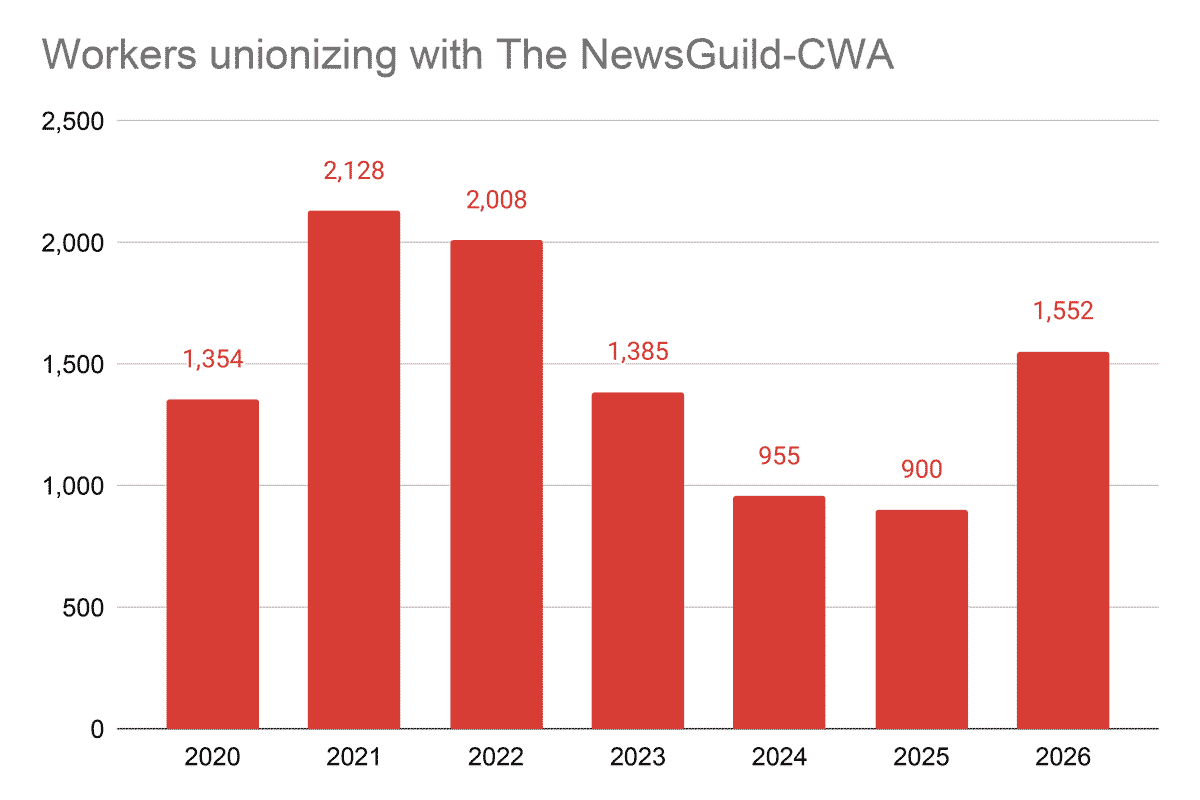
A lot has changed in 93 years, but these recent wins are part of an explosion of workers organizing with us in the past several years.
A staggering 10,282 workers have joined our ranks at 241 workplaces in the past seven years, including 1,552 workers who’ve joined us so far this year. (And it’s not even August yet!) I’m shaken and humbled that we’ve been able to build one of the fastest growing private-sector unions in North America these last several years. That’s only been possible because of your determination to stand up and fight for yourself and your coworkers.
Workers at Hachette Book Group became the largest union in trade publishing history after more than 600 workers voted to join WBNG. The company refused to voluntarily recognize the workers after they went public in April, setting up an election under the National Labor Relations Board.
The Board counted ballots and 75% of workers voted to unionize. They’re the second group of workers to unionize out of the “Big Five” publishing houses.
I spoke with Eric Arroyo, a digital production coordinator at Hachette. He’s been at the publisher for three years and joined the organizing committee nine months after starting.
He was “identified” by a coworker after he spoke up during an artificial intelligence town hall. That colleague later became a member organizer after several rounds of layoffs. A member organizer is exactly as it sounds: a union member who we train up to help others unionize. Typically, they do this in another workplace after they’ve won, but sometimes they help former coworkers.
Arroyo told me that publishing houses rely on depressed benefits and pay across the industry and take advantage of the reasons that workers got involved in book-making in the first place.
“Publishing has a culture of underpayment,” Arroyo said. “There’s an understanding that folks who enter publishing and make books are there because they have a higher purpose. That has been exploited and understood as the norm for decades.”
Arroyo left a job at Amazon to join Hachette because he wanted to work at a place “where the agreed upon goal was to make books.”
Management at each of the “Big Five” publishing houses will point at each other’s abysmal pay and say that’s just the way it is. They’ll say they pay competitively, but the only gains have come from the one unionized publishing house: HarperCollins. New York Times Reporter Alexandra Alter wrote about this history in a piece about Hachette workers unionizing.
Arroyo said the issues go beyond wages. The backlash against diversity and the rise of artificial intelligence were also major factors pushing workers to unionize, along with the increased cost of living in a city where Hachette has an office. (Side note: more than 90 Guild contracts now have AI language in them.)
“We’ve taken this tax on our own wages because we care about the thing we do, but we’re losing our control and our respect and dignity,” he told me. Their expertise and long careers with a publisher aren’t valued anymore while publishers continue to make profits and increase executive pay.
So, Hachette workers voted union yes to demand that respect and dignity.
Similar issues motivated University of Chicago Press workers, who won their union the very next day. Workers won the union by a decisive 89%.
I spoke with Matt Lang, a senior editorial associate who’s been at the Press for eight years. He said several of his coworkers work multiple jobs to make ends meet.
“If we can make an industry that’s run on exploitation a lot fairer, it’ll benefit us and everyone who starts to work in this industry after us,” he said.
University of Chicago Press workers went public in May and outlined priorities in pay equity, sustainability and transparency.
Without a say, workers were beholden to unilateral decisions by university management. Lang pointed to the COVID-19 pandemic, when the university management cut retirement benefits.
“Folks who have worked at the university for 20 years or more had no seat at the table and no way to participate in decisions being made during COVID.”
As artificial intelligence continues to expand into our lives, Lang and his coworkers also wanted a say in how AI is implemented. The university has signed contracts with tech companies.
Lang said AI can speed up some minutiae in the book editing process. But he flagged that workers wanted a seat at the table because if a boss argues AI can save time on one end of our task list it could just create more time and labor on the other end.
He’s excited about what comes next as they prepare to bargain for their first agreement, filing information requests with the boss, getting more transparency and surveying fellow members.
Congratulations to our newest members and to everyone who helped out on these campaigns!
They were a long time coming. I looked back at my notes and we were supporting Hachette workers as far back as 2021!
Here’s other news across the Guild:
Journalists at The Maine Monitor launched their union and were immediately recognized by management, joining The News Guild of Maine. The nonprofit news organization’s board convened and unanimously voted to voluntarily recognize the union after workers went public.
“We are thrilled that senior leadership and the MCPIR Board chose to voluntarily recognize our union,” said health care and general assignment reporter Emily Bader. “This is a great step forward in fulfilling our mission and we look forward to working with management in the weeks and months to come.”
“We are thrilled to welcome the workers of The Maine Monitor into our union. This step will strengthen a respected news organization and enable these journalists to continue their important mission in our state,” The News Guild of Maine president Megan Gray said. “Media workers and journalists in Maine have sent a clear message in recent years with campaigns to form and expand our unions: We care deeply about our work, and we will be part of the conversation about the future of the news industry in Maine.”
New York journalists at Schneps Media voted 90% to unionize with the Independent Association of Publishers’ Employees (IAPE), Local 1096. They’re joining workers at The Wall Street Journal and Dow Jones who have been part of IAPE for decades.
This is the first external organizing win for IAPE, a major accomplishment to build power by supporting more organizing of journalists and media workers in New York City. (NY Guild: watch out!)
“We, the reporters of Schneps Media, are elated to finally have won a seat at the table to negotiate for livable wages, affordable health care, and stronger editorial guardrails,” said amNew York reporter and organizing committee member Ethan Stark-Miller. “After a year and a half of worker-led organizing and a robust public campaign, Schneps reporters voted overwhelmingly today in favor of securing improved working conditions. Our campaign also overcame a concerted anti-union effort from management, including an onslaught of emails, calls, and one-on-one meetings aimed at swaying us to vote no. But today we came together to loudly say YES to unionization!”
“IAPE is thrilled with the monumental win of the Schneps Media Union and looks forward to negotiating with the company to create a fair contract that protects worker rights, ensures fair treatment of workers and guarantees employees are paid what they deserve for the great work that they do,” says IAPE Local President Jodi Green.
Dozens of workers are unionizing at the Aboriginal Peoples Television Network and joining the Canadian Media Guild and coworkers already unionized at APTN. They filed with the Canada Industrial Relations Board after a majority of the 60 workers signed union cards. They’re based across Canada, with the main offices in Manitoba.
More than 80 workers are already members of CMG at APTN, which is a national Indigenous media organization that shares programming celebrating the diversity of Indigenous Peoples in Canada and abroad.
“By coming together, we strengthen our ability to support one another, advocate for our wellbeing, and create a sustainable future for the people who make APTN possible,” workers said in their mission statement.
“We are happy to welcome these talented and determined media workers into the union. They put in so much time and effort to organize themselves around shared issues in the workplace,” said Jane Robertson, national president of the CMG. “When people do that work to organize, they create lasting change for themselves and those who follow.”
Our members in Idaho and Washington state won strong artificial intelligence protections in their recent contract. You can hear all about it at 8 p.m. ET August 5 in a town hall members are hosting to share out their victory. Workers can’t be laid off or have their hours reduced because of AI and unit work can’t be done by AI unless it’s in direct control by our members. Register for that town hall here.
Other members in the Pacific Northwest Guild local just completed a short strike against Adams Publishing, who was pushing regressive language at the bargaining table. Workers have beaten that back and showed the company they are not messing around. They’re willing to withhold their labor and go on an open-ended strike if Adams doesn’t get serious.
“While we’re incredibly short staffed, we still take the time to write stories and take photos/videos of our local community,” they wrote on social media after returning to work and pointing to an even thinner newspaper. “Without us, the paper has very little value.”
Congratulations to member Aparna Raj! She’s been a member of the Washington-Baltimore News Guild and been part of the bargaining committee at Local Progress in D.C. This summer she won the Democratic primary to represent Ward 1 on the Washington, D.C. Council (which is my Ward!). She’s now left Local Progress and she’ll get to work on the council in January after the general election, which she’s expected to win.
Lastly, some really good news.
Our member Eustaquio Orozco Verdusco is home with his family after being detained by the U.S. Immigration and Customs Enforcement since January. About a dozen supporters, including our Executive Vice President Marian Needham, myself and Minnesota Guild members and staff and lawyers from the AFL-CIO, joined a bond hearing for Eustaquio in June.
He began to smile as folks introduced themselves one-by-one on the WebEx. We even flew a couple of his coworkers to be there in person. And you could see the warmth he felt when his son called out his name.
Eustaquio fought to reclaim stolen wages of construction workers in Minnesota as part of Centro De Trabajadores Unidos En La Lucha (CTUL). He’s been an organizer and shop steward along with being a husband and a dad.
Sadly the judge issued his verdict that day and ordered Eustaquio continue to be held in an ICE detention center in New Mexico.
But the next day we got surprising news. A separate legal victory in ICWC v. Noem appeared to help, one of the paths lawyers also pursued.
“Hello beautiful people!” he said on social media. “Thanks to God and the support of each of you I am back home with my family enjoying the company of many of our friends. My family and I are very thankful to you all for your support during this very difficult time we have gone through. Thank you for all of the prayers, blessings, hugs, and tokens of appreciation that we have received during my absence and my return. I believe, and I have said it many times, that there are more of us good people. Thank you for your love, your good will, and I hope to thank each of you in person very soon.”
Here’s Eustaquio with his son after his release.
Go into the weekend and build community with your coworkers, your neighbors, your friends and your family.
We have more power than we know.
In solidarity,