When I walked through the DCA airport at 6 a.m. this morning I saw a woman wearing a shirt that read, “feral for a free press” and I thought it might be a good day. It was.
On Thursday, U.S. District Judge F. Dennis Saylor called out the Trump administration for imposing new restrictions on the duration of visas impacting international journalists and students. The changes impact F, J, and I visas and change how long students or journalists can stay, adding massive barriers if they need to extend their time in the United States.
“I think that the uncertainty point in terms of the impact of the potential irreparable harm is enormous,” Judge Saylor said.
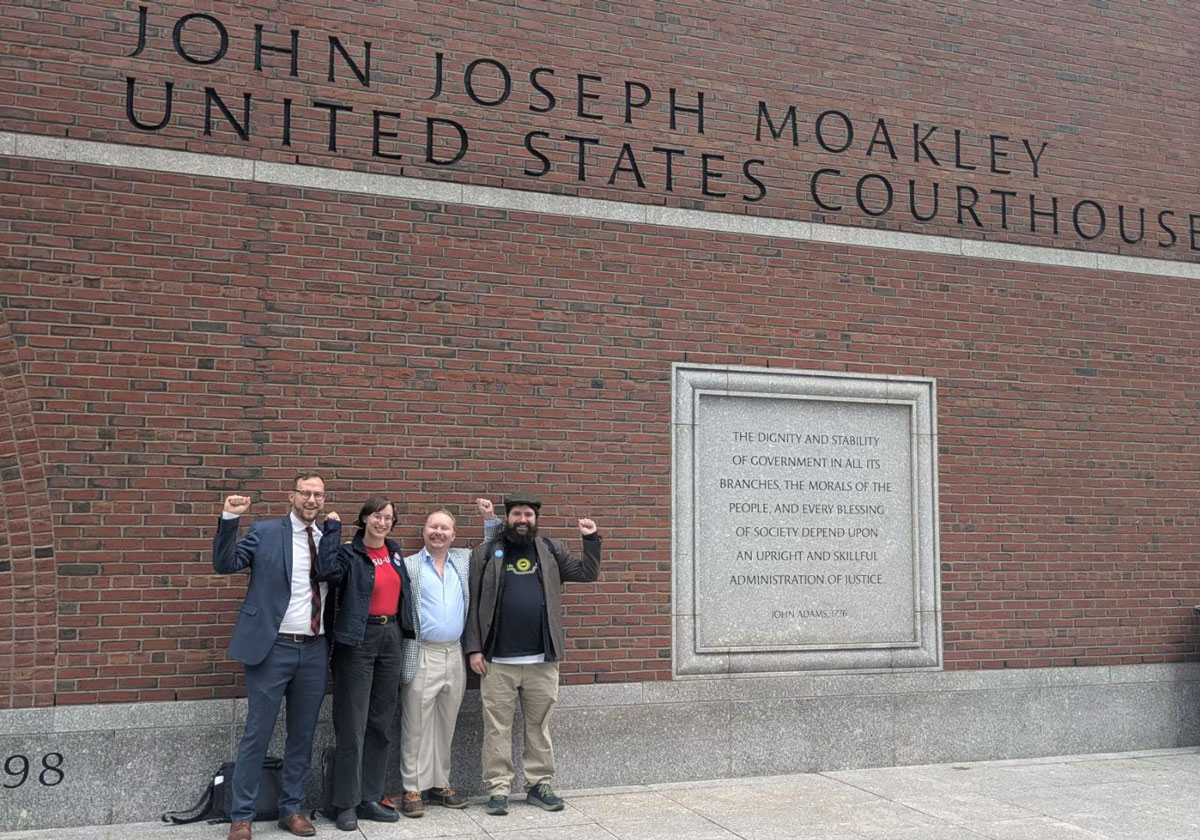
I flew to Boston on Thursday to join other unions and academic groups in our lawsuit against the Trump administration.
The Guild represents dozens of journalists in the United States working on I visas at several outlets including Le Monde, EFE, Agence France-Presse and Reuters.
The U.S. Department of Homeland Security has shortened the length of stay from 5 years to just 240 days for journalists. The changes will go into effect on September 15 unless Judge Saylor intervenes. In court on Thursday he intimated that he might likely issue temporary injunctive relief..
The government argued that national security is a chief issue necessitating these changes, but provided very little evidence of this in filings.
“Isn’t all the evidence anecdotal?” Judge Saylor asked.
“What’s going on here in terms of national security is the government is hiding behind these doctrines to give the president vast powers in national security matters that he does not possess,” he said.
“And I’m struggling to see any real rational connection between the national security issues identified, which is not even half a dozen isolated incidents over a period of nearly 50 years,” he said.
Last month The NewsGuild-CWA joined unions and higher education groups in suing over the final rule implemented by DHS. Most of the arguments in court today centered around the impacts on changing the duration of F and J visas impacting international students, which would restrict those visas and make it more difficult to extend studies or engage in paid training and internships.
One of those students is Abbie LeBlanc, a 29-year old Harvard PhD student from New Brunswick, Canada and member of UAW Local 2322. I sat next to her and she told the Boston Globe today that graduate students at Harvard have been anguishing over the changes for the last few weeks.
The lawyer for our coalition argued Judge Saylor should issue a preliminary injunction halting the visa changes and also issue a summary judgement deeming the changes in violation of the governing statute, the Administrative Procedures Act.
While most of his arguments were about how the changes would negatively impact universities and international students, he also highlighted how changes to I visas would chill the reporting by journalists on visas because “what they’re publishing is part of the material that gets submitted during [visa] renewals.”
He pointed to the government’s argument that there won’t be a chilling effect, however, “that fails to actually wrestle with the fact that when reporters are on a 240-day renewal clock, they’re going to feel significant pressure to temper their reporting” that could be viewed as critical of the Trump administration.
The lawyer read from my declaration and said that many international journalists come to the United States to work for extended periods of time. They rent homes with leases extending well beyond 240 days. Their children are enrolled in U.S. schools and they have spouses in the U.S.
He highlighted the story of how one of our members was criticized and attacked by government officials for having reported on allegations that an ICE officer caused the death of a protester.
“We think the nature of the retaliation is real,” he said.
Before adjourning, the judge noted that the new rule will go into effect on September 15.
“One possibility is that I might issue a brief TRO to give myself some more time,” he said, using an acronym for “temporary restraining order.” He then added, “I don’t know that I’m going to do that or not, but I’m just putting that possibility out there.”
“I’m glad to hear our case so well represented,” said Michael Ziegler, president of the Graduate Labor Organization, before adding that he was happy to hear the court have a degree of skepticism of the government’s arguments. Ziegler represents graduate student employees at Brown University and they’re part of the American Federation of Teachers.
“Our union local and the UAW got involved to protect the freedom to research and the freedom to learn and teach,” said Patrick Burke, president of UAW Local 2322, which represents international student workers and post-doctoral researchers at the University of Massachusetts Amherst, student workers at Worcester Polytechnic Institute and graduate student workers at the University of Vermont. He said he was proud to be in this fight with other unions like the Guild to protect our freedoms.
The plaintiffs in the case include the Guild; NAFSA: Association of International Educators; the Presidents’ Alliance on Higher Education and Immigration; the Association of Independent Colleges and Universities in Massachusetts (AICUM); the American Federation Of Teachers (AFT); Graduate Labor Organization, AFT Local 6516 (GLO); International Union, United Automobile, Aerospace and Agricultural Implement Workers of America (UAW); and United Auto Workers Local 2322.
We’ve filed several other lawsuits against the DHS and Trump administration officials after federal agents assaulted our members in Illinois, California and Minnesota.
I was proud to be in court today to represent our members. What DHS is doing is illegal. We must stand up against a president who continually undermines our First Amendment. I never dreamed I would be spending so much time in court suing a president violating our constitution and the rule of law. But here we are. We must do whatever it takes to hold power to account.