A federal judge issued a nationwide injunction on Monday, halting the Trump administration’s latest efforts to impose new restrictions on visas primarily used by students and international journalists.
The changes would have severely limited the duration of visas for journalists working in the United States for international news outlets, and placed additional restrictions on how long students can remain in this country and whether they could change or extend their planned studies.
In his decision, the judge noted that the U.S. Department of Homeland Security (DHS) failed to provide any reasonable explanation for why it needed to cut the time international journalists are permitted to work in the country to a maximum of 240 days. Currently, journalists admitted on this type of visa can stay for multiple years.
This is the third injunction the Guild has been involved with winning against the Trump administration, with NewsGuild-CWA President Jon Schleuss calling this temporarily halted policy an attack on journalists, and one that is “clearly designed to chill” their reporting.
“We welcome this preliminary injunction as a first step toward ensuring that foreign journalists in the United States can keep reporting freely,” added Schleuss. “This judge agreed that the Trump administration offered no evidence that shortening foreign journalists’ visas protects national security in any way.”
U.S. District Judge F. Dennis Saylor highlighted Homeland Security’s attempt to limit international journalists, writing that they could apply for an extension “under a process that calls for the entirely unguided exercise of discretion by government officials, with no recourse and no appeal.”
The judge also specifically noted the possibility that the now-blocked change could be abused, writing “in particular, the obvious likelihood that the visas of foreign journalists who are critical of the government (or, more particularly, DHS officials) will not be renewed.”
“The weakness of the connection between the rule and its purported rationales raises legitimate questions as to whether its real purpose is not to safeguard national security and protect our borders, but to achieve other, undisclosed, goals—such as, for example, asserting greater government control over academic institutions and the press,” wrote Saylor in his decision granting the preliminary injunction. He also noted the attempted change by the U.S. government “raises the very likely possibility of retaliation against American journalists working abroad.”
The injunction halts the implementation of the new rule while the case is heard in court, but further timelines are unclear.
The Guild’s membership includes dozens of journalists in the United States working on I visas at several outlets including Le Monde, EFE, the CBC, Agence France-Presse and Reuters.
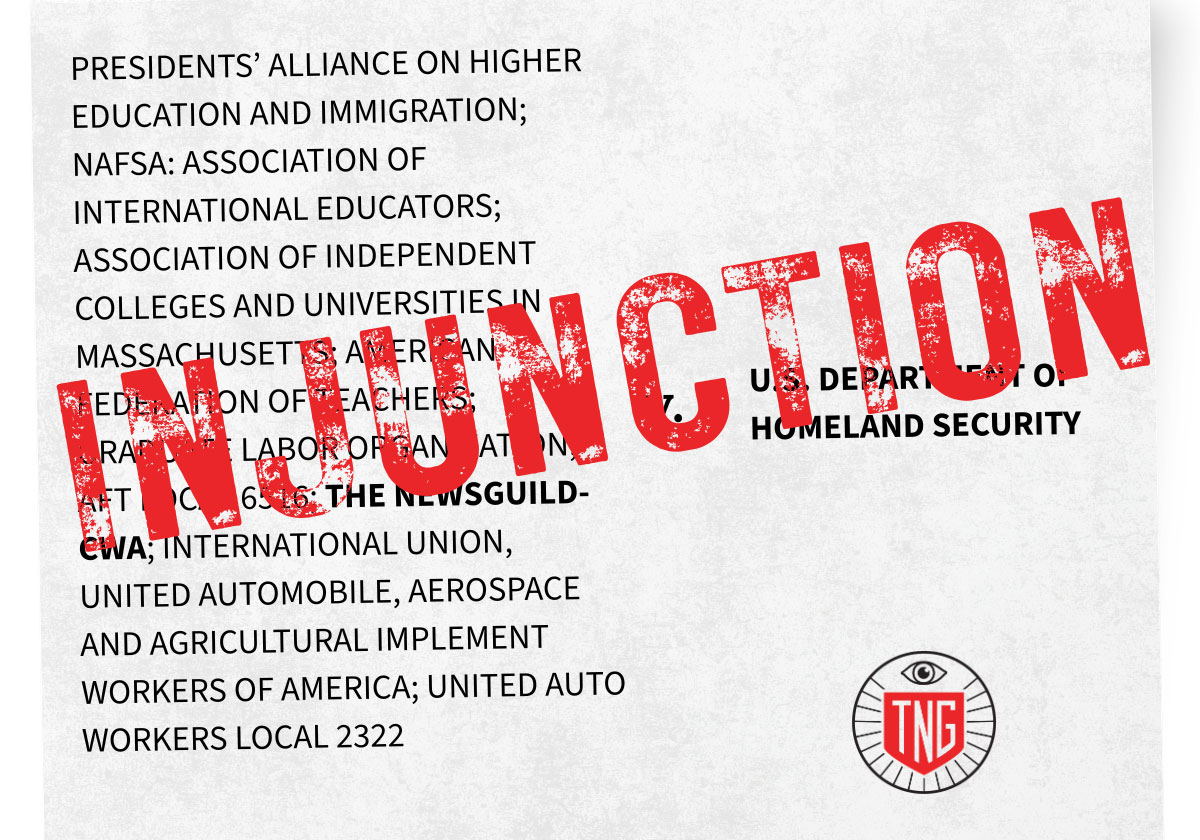
The Guild joined a coalition that filed this lawsuit in August. The plaintiffs in the case include the Guild; NAFSA: Association of International Educators; the Presidents’ Alliance on Higher Education and Immigration; the Association of Independent Colleges and Universities in Massachusetts (AICUM); the American Federation Of Teachers (AFT); Graduate Labor Organization, AFT Local 6516 (GLO); International Union, United Automobile, Aerospace and Agricultural Implement Workers of America (UAW); and United Auto Workers Local 2322.