Our members at The New York Times Guild are currently bargaining their next collective agreement. What happens in these negotiations will impact the rest of the news industry.
On Wednesday, hundreds of workers at the Times, represented by The NewsGuild of New York, took part in an action flooding management’s inbox with emails outlining five major priorities in their contract fight. A big priority on that list: artificial intelligence, which is a critical issue in several newsrooms, from ProPublica to the 50 unionized newsrooms at Gannett (aka USA Today Co.).
Guild members scheduled a new email to be sent at the top of each minute, beginning before 8 a.m. Eastern Time. Hundreds of emails crowded the inboxes of Times’ top brass.
The first email was fired off by Isaac Aronow, an associate editor on the games team who’s on the Guild bargaining committee, on the contract action team and a shop steward. He’s also the co-chair of the Times’ AI subcommittee.
I spoke to Isaac by phone while the emails were piling up in executive inboxes to talk about management’s stance on artificial intelligence. We discussed the tools being used in the newsroom, how AI can actually help journalists and how management is responding to the ethical protections proposed by journalists. I’m including an excerpt here before sharing other latest news from across the Guild. Read the full interview (and see management’s response!) on newsguild.org.
So what are y’all pushing for at the bargaining table?
Right now the company seems to want complete control of how AI is used in the newsroom. That’s what’s concerning to me.
We are asking for two things in our AI proposal. First, we want a share of the licensing income that the company earns from licensing the work that we’re doing every day for AI training.
In our current contract, if I write an article that gets licensed in Brazil, I get a percentage of that income. But now if they license the entire corpus of work, we get nothing. That’s completely unfair.
The other thing we’re pushing for is ethical protections around AI. We don’t want them to make digital simulacra, essentially digital versions of us.
I don’t want management making videos of us or an AI-generated robot Isaac talking about sudoku tips or AI generating my voice. So, we’re pushing for protections in that regard.
We also want to disclose how AI is used in the reporting process. If text was generated, we should disclose that so readers continue to trust us. That’s the main thing. It’s a two-way street. Ethical protections help us to do more rigorous high quality journalism and it makes sure that readers know a real person is talking to other real people and getting real scoops.
One thing I say a lot is that AI is not going to ask hard questions of people who need to be asked them.
That work is always going to exist.
So, the company has completely agreed to everything?
God no.
We passed our AI proposal in our first bargaining session. The company returned it in the second session fully struck out and replaced it with the language in the Times Tech Guild contract. That language would create a discussion committee. We’ve heard from our co-workers covered by that agreement that without language mandating our agreement and stringent enforcement, this language doesn’t address our collective concerns.
Spoiler alert: that already exists and I’m the co-chair of it. We have a committee already and we meet somewhat regularly.
But in a later bargaining session we returned a counter after the company struck out everything. It was essentially identical to our original proposal, but we included a version of their committee language. They returned us a struck-out counter in which they included a waiver. At the table they would not admit it was a waiver, but it was.
They’re still looking for complete control. In particular, they struck out our licensing language. But left in the part about them being able to sell our data for AI training. But they don’t want to give us any money for it.
That’s where we’re at now. And we’re doing actions to move the company in this area.
Keep reading my conversation with Isaac on our website, where you can also see management’s response to my request for an interview.
There has been a lot of other news across our union, so let’s dive in!
Staff at Current Affairs unionized with the Chicago NewsGuild. Workers got voluntarily recognized by Nathan J. Robinson, the editor-in-chief at the politics and culture magazine. “Membership in the News Guild will allow us to maintain the high standards in wages and working conditions we’ve experienced at Current Affairs, allowing us to do our best work and provide you with the high-quality writing, art, graphic design, and political analysis you’ve come to expect,” workers wrote on the magazine’s website today.
Journalists and other workers at the Fort Worth Report just won their union, voting 11-1 in favor of joining Media Guild of the West. Results came minutes ago in an election administered by the National Labor Relations Board. Management refused to voluntarily recognize staff in January, triggering the election. The company hired a union-avoidance firm (ew, david!) and tried to convince workers to oppose unionizing.
“These results were not based on mob rule, but rather a reflection of every single unit member who has been heavily involved in this process since its launch,” the Guild’s organizing committee said. “This is the next and vital step for our community newsroom, and we look forward to steering trusted news forward in Tarrant County together.”
Last week workers at Chemical & Engineering News won a union in a landslide, with 96% of participants voting in favor. The campaign was announced last year and brings the union to reporters, designers, production staff and platform editors.
“This is an important first step for the C&EN Guild,” said life sciences reporter Rowan Walrath. “We look forward to securing the protections we need to make C&EN a great place to work—and an influential publication—for the next 100 years.”
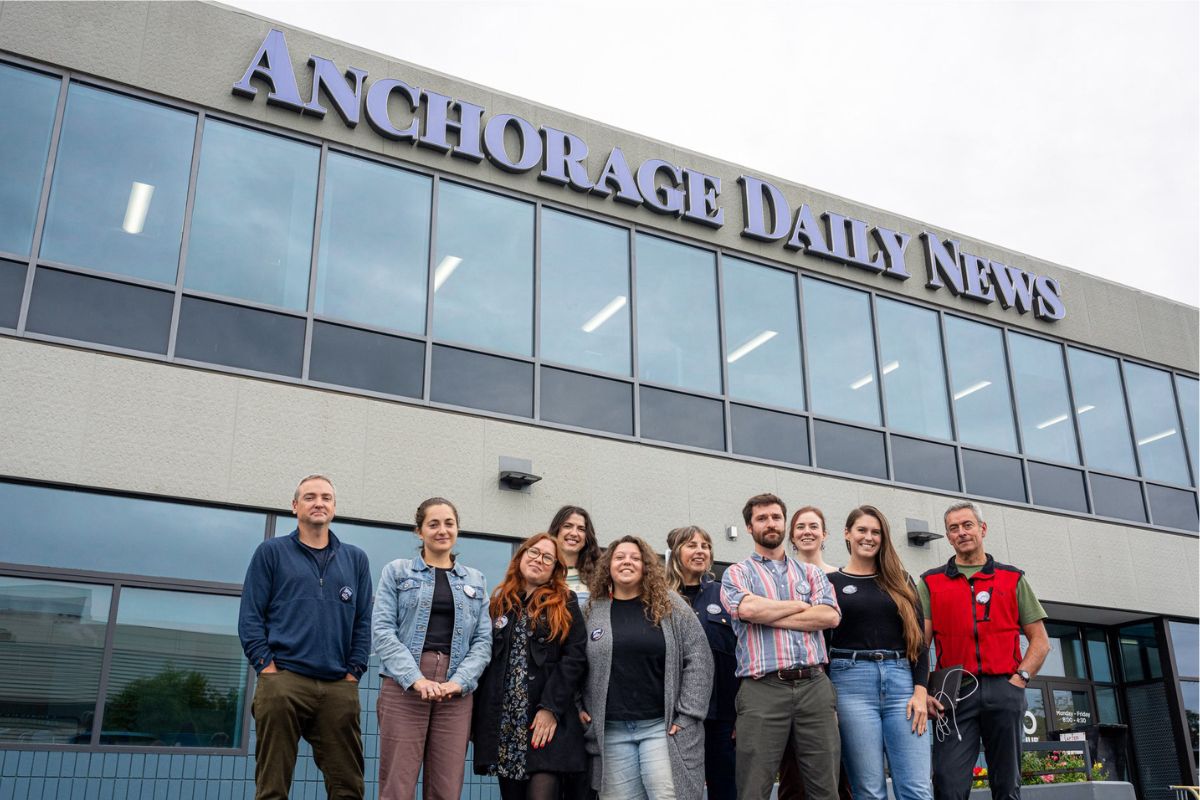
We just won our first contract ever in Alaska after workers at the Anchorage Daily News ratified the agreement. Just about a year-and-a-half after winning their union, journalists won an agreement that increases minimum salaries, provides job protections, immediately gives workers raises, increases coverage for mileage and training and more.
“This is a big achievement for Alaska journalists. It feels like we’re laying a foundation for the next generation to work in a sustainable, transparent newsroom,” said reporter Kyle Hopkins.
Workers also praised management, which is rare to see. Usually management is pretty terrible during negotations, but there’s no reason for them to act that way. And thankfully, owner Ryan Binkly was different.
“I’m grateful to my colleagues and to management that we were able to come together, bargain in good faith, and work towards a contract reflecting both our aspirations for the organization as well as the realities facing it. It’s a hard time for journalism,” said reporter Zachariah Hughes.
“The fact that we have a local owner who lives in Alaska, cares about it and recognizes the challenges facing it is one of the major reasons we were able to get a contract done in under a year. While our members didn’t get everything we wanted, we got a heck of a lot more than we had. We are all looking forward to being able to recommit our energies fully to the hard work of reporting and covering the news, and believe getting this union up and running makes us better able to do that.”
Law360 members told their owner to cut ties with ICE, with more than 200 journalists telling owner LexisNexis demanding they cut ties with the U.S. Immigration and Customs Enforcement.
The letter criticized the owner for “doing business with an organization that regularly flouts the ‘rule of law’ principles the company says it upholds.” Workers demanded a town hall to ask questions about the contract the company has with the agency and transparency around the status of that contract.
We won a victory last night in our lawsuit supporting our members at Radio Free Asia after a judge ruled that Kari Lake was illegally serving as acting CEO. Judge Royce Lamberth granted a motion for summary judgement nearly a year after we filed our lawsuit alongside other unions representing Voice of America, individual journalists and other media workers. We issued a press release alongside the other unions and organizations.
It turns out Kari Lake and the president have to follow the law. Unfortunately, Lake illegally delayed and avoided Congressionally-mandated payments, creating chaos at the grant-funded newsroom. Her actions put more than 100 of our members at Radio Free Asia in limbo. We negotiated severances for our members to give them a chance to move on to something new. It’s such a shame because they covered news in nine languages, broadcasting into repressive countries like North Korea, Vietnam and Tibet. We’re still fighting and will continue to hold power to account.
Our victory was covered in POLITICO, NPR, The New York Times, the Washington Post and more.
Idaho and Washington journalists at McClatchy want better pay not overpriced “swag” with a sad corporate logo.They’re calling on the chain to pay better and soon. The company the same as Post Media in Canada and all owned by Chatham Asset Management.
We’ve got a few events we’re doing or sponsoring coming up!
Want to know how to win a union election? At 7 p.m. ET Wednesday, March 18 we’re holding a training on best practices in running certification campaigns and winning at the National Labor Relations Board. Register here
Steward training module 3 continues for our west coast (best coast?!) family from 5:30 – 7:30 p.m. PT. Learn how stewards drive the exchange of information and uphold an organizing culture throughout their union. Register here
We’re sponsoring an organizing training in New York City, joining the UAW and the Emergency Workplace Organizing Committee who are running the training for non-unionized workers in New York, so they can learn skills needed to build a campaign and win a union. That’ll be at 1 p.m. on March 21 in New York. RSVP for the free training here. And tell your non-union friends and non-union family. And tell your NYC neighbors.
More than 23 media unions formed each year on average since 2020, according to an analysis by Axios. Most of those were with us. The stellar graphics included in the subscription-only piece show a wild number worker unionizing with us and really interesting trends in when we strike and when we win a collective agreement. (Hint: you strike, you win shortly after.)
Finally, I was in Indianapolis last week for NICAR, which stands for the National Institute for Computer-Assisted Reporting. I’ve been going for years and I got to spend time with more than 100 members from dozens of newsrooms. I also even helped teach a class for map nerds!
We joined the Indianapolis NewsGuild hosting a happy hour for all union and union-curious journalists at the conference. I met our members from ProPublica, CalMatters, the Columbus Dispatch, Reuters, Washington Post, the Philadelphia Inquirer, WSJ, the Detroit News and of course The Indianapolis Star! Special shout out to John Tufts, trending reporter at the IndyStar who’s a Foo Fighters fan. I told him I’d put a labor song recommendation in the newsletter. So, here it is, John! “(In Remembrance of the) 40-Hour Week” by Lee Baines + The Glory Fires. Spotify and Apple Music
Have a good week, fam!
In solidarity,
Jon Schleuss