Journalists rarely make themselves the story. Our job is to report what’s happening in our communities, interview sources, verify facts and hold power to account so the public can make informed decisions. But on Tuesday night, journalists from across the United States did something unusual: they told their own stories.
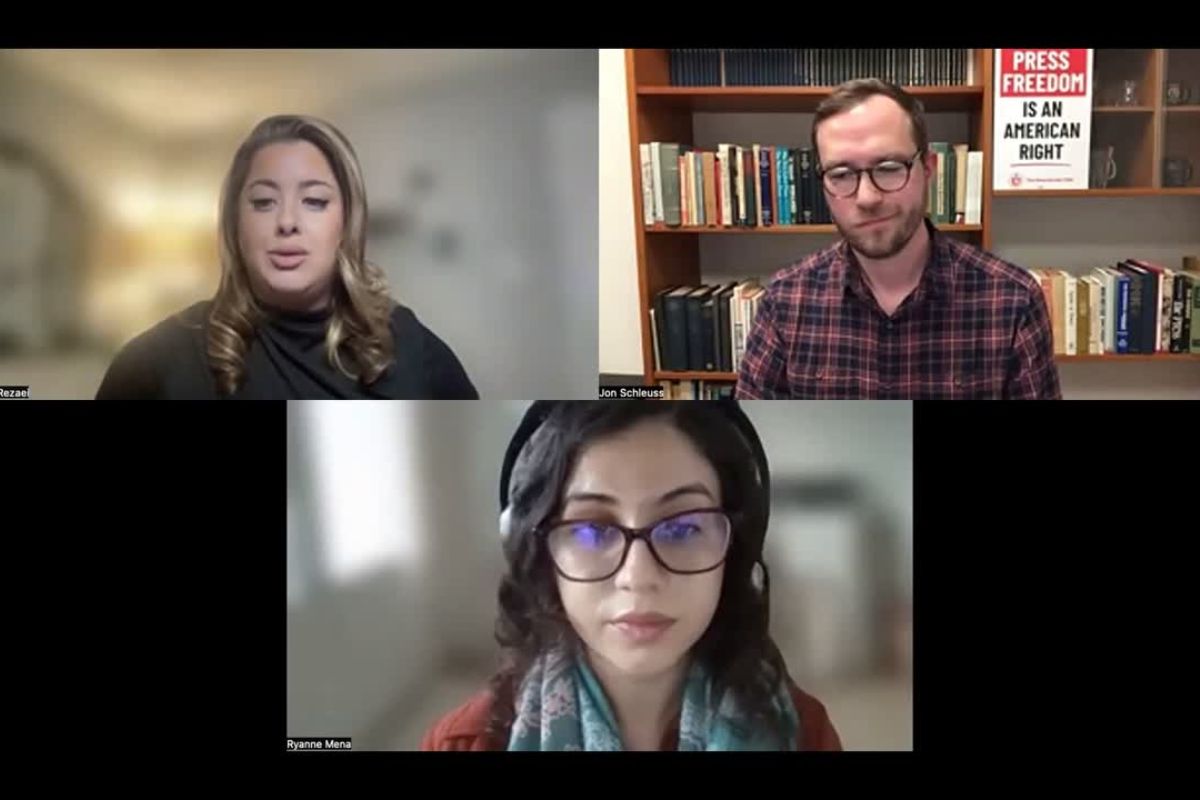
The national town hall, “Journalists Tell Their Own Stories: Authoritarianism and the Free Press,” brought together reporters, editors and media workers to speak directly about the rise of authoritarianism in the United States and the growing attacks on press freedom.
Moderated by Jon Schleuss, president of The NewsGuild-CWA, the event featured journalists from large broadcasters, regional newsrooms, magazines and smaller outlets. These voices rarely center themselves, but did so here to explain why defending journalism is essential to democracy.
A Moment of Crisis for Press Freedom
Press freedom sits at the very top of the Bill of Rights. Journalism is the only profession explicitly protected in the U.S. Constitution because democracy depends on a free and independent press.
Yet journalists are facing a rapidly worsening environment. Speakers detailed a disturbing escalation of efforts by the Trump administration to suppress independent journalism, weaken public trust in the press and intimidate news organizations. The authoritarian actions journalists discussed included:
- FCC investigations into NPR and PBS, followed by defunding by Congress and the president and the shutdown of the Corporation for Public Broadcasting, leaving public radio and television stations without adequate funding
- Threats by the FCC to block media deals unless companies dismantle diversity, equity and inclusion efforts
- Lawsuits brought by the president against news organizations, including CBS, ABC and the BBC—several of which settled despite legal experts viewing their cases as strong
- The blocking of the Associated Press from White House events over its refusal to change long-standing style guidance on the Gulf of Mexico
- An executive order dismantling the U.S. Agency for Global Media, cutting funding for Voice of America, Radio Free Asia and other outlets broadcasting into repressive countries
- New Department of Defense rules restricting journalists’ access to information, prompting mass walkouts by reporters covering the Pentagon
- The White House seizing control of the press pool from the democratically run White House Correspondents’ Association
- Repeated attacks on journalists as “enemies of the people”
- Efforts by the Department of Homeland Security to restrict visas for international journalists working in the United States
- The targeting of journalists by ICE and federal agents who have opened fire on media workers in Chicago and Los Angeles while they are on the job
Taken together, these actions aim to weaken journalism with intimidation, propaganda and violence in an effort to silence reporting that exposes the truth and holds power to account.
Journalists Targeted While Doing Their Jobs
The first half of the town hall platformed journalists who were injured on the job while covering protests.
Ryanne Mena, a journalist covering protests in Southern California, described being shot with pepper balls by federal agents while clearly identified as press and wearing press badges issued by the local sheriff’s department. On June 6, she was struck in the thigh despite wearing two press badges and carrying a notebook and pen. The following day, she was hit in the head with a rubber bullet while covering another protest and was later diagnosed with a concussion.
Ryanne emphasized that people deserve to know when journalists are harmed by their own government. Her reporting and subsequent legal action helped lead to a preliminary injunction preventing DHS agents across Southern California from using force against journalists in the field.
Asal Rezaei, a CBS Chicago journalist, recounted being shot at by ICE agents while reporting near a detention facility outside Chicago. Working a long shift, she drove to a secondary entrance to assess activity when a masked federal agent fired a pepper ball at her personal vehicle. With her windows down, the chemical agent engulfed her car, leaving her vomiting and struggling to breathe.
Despite the trauma, Asal went on air shortly afterward to report what had happened. She later spoke about the anxiety of becoming the subject of the story and the emotional toll that followed while returning to the field just days later because, as she said, the work is too important not to continue.
As an Iranian immigrant who became a U.S. citizen shortly before the election, Asal underscored how personal press freedom is. In many countries, journalism itself is a crime. Here, she said, journalists have a responsibility not to take that freedom for granted.
Holding Power to Account Inside the Newsroom
The second half of the town hall focused on journalists confronting authoritarianism within their own workplaces.
Alma Avalle, a Conde Nast member at Bon Appétit who was fired by Conde Nast illegally in November, described how Teen Vogue’s ambitious, youth-focused political coverage, which often addressed issues like climate justice, rising authoritarianism and gender-affirming care, came under increasing pressure. As corporate leadership sought to avoid scrutiny from the Trump administration, major sections were eliminated, resources stripped and journalists—particularly journalists of color and trans journalists—pushed out.
When journalists attempted to question management about these decisions, Alma and several colleagues were terminated. The message, Avalle said, was unmistakable: media executives were not to be challenged.
Steve Mellon, a veteran journalist, reflected on the painful decision to strike after his publisher at the Pittsburgh Post-Gazette unilaterally tore up a contract, cut benefits and violated federal labor law. Having spent decades covering labor actions as a reporter, Mellon described stepping onto a picket line as a worker as difficult, but ultimately unavoidable. “I couldn’t face myself or my daughters if I didn’t stand up,” he said.
Community support from fellow journalists, unions and readers proved critical. After years of organizing and legal battles, workers ultimately prevailed, showing that solidarity can counter even entrenched corporate power.
Building Journalism That Can Withstand Pressure
Mitch Grummon, publisher of The American Prospect, spoke about the importance of sustainable, independent business models. News organizations that rely primarily on reader support and diversified revenue, rather than corporate advertisers, are better positioned to resist political pressure and intimidation.
True independence, he noted, begins with a simple question: Who pays your bills?
How You Can Support A Free Press
The town hall closed with a call to action to sign the petition demanding our elected representatives in the U.S. Congress defend the free press and protect the First Amendment.
There are concrete ways the public can help:
- Stand with journalists when they are attacked or discredited
- Subscribe to local newsrooms, especially unionized outlets
- Support public media
- Follow and support journalism unions and organizations, including The NewsGuild-CWA, Writers Guild of America East, National Writers Union, NABET-CWA, Freedom of the Press Foundation, National Association of Black Journalists, PEN America and Reporters Without Borders
- Sign our petition to Congress demanding the free press be protected
At a moment when press freedom is under direct attack, journalists are still doing their jobs. They are asking the public to stand with them because a free press is not just a journalist’s right. It is an American one.
A major thank you to everyone who helped make this town hall possible, including Writers Guild of America East, The National Writers Union, NABET-CWA, PEN America, Reporters Without Borders (RSF), Freedom of the Press Foundation and the National Association of Black Journalists.